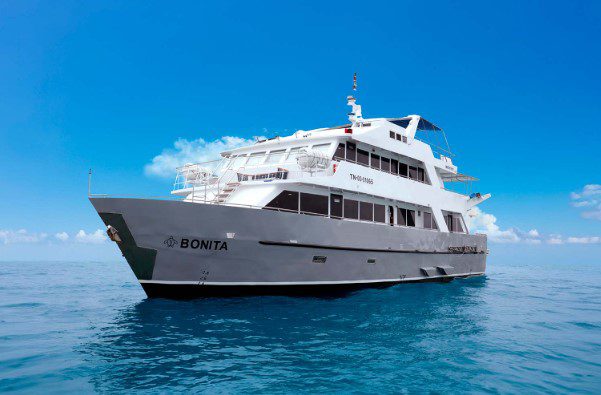
Specification & Deck plan
Security Equipment
- 6 lifebuoys
- 2 survival rafts, 15 guests each
- 30 life jackets for guests
- 20 life jackets for crew
- Flare gun, smoke signals, SOS flashlights signals
- CO2 extinguishers
- Fire detectors and complete fire protection system
- Fire extinguishers
- External automated defibrillator
- Fire suits
Dimensions
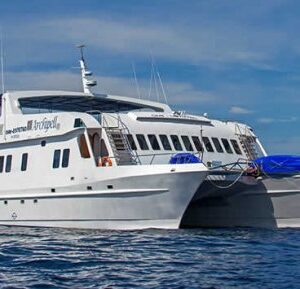
- Length: 31.50 mt2 /101.70ft.
- Beam: 10.50 mt2 /34.44ft.
Deck Plan

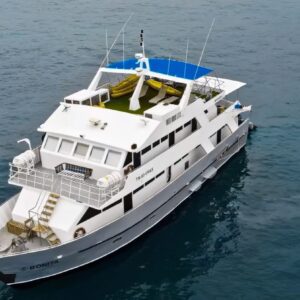
SUNDECK
The spacious solarium, which offers a beautiful view of the ocean, is equipped with comfortable deck chairs.

UPPER DECK
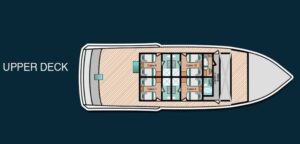
On the upper deck, there are four double or twin cabins, the captain’s cabin and the bridge.
MAIN DECK
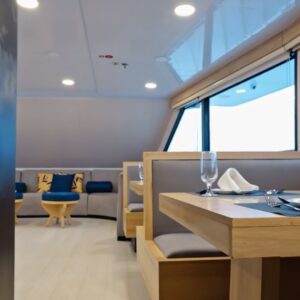
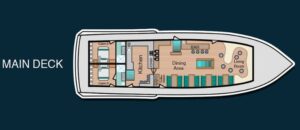
On the main deck, in addition to the 2 cabins, we have the dining room with the purified water and hot drinks station available 24 hours a day, as well as the lounge, bar and kitchen.
LOWER DECK
On the lower deck, there are 3 cabins, the guide’s cabin, the crew’s cabins and their dining room.
Guest Accommodation:
MATRIMONIAL CABIN
Cabin Size: 10m2
In the upper deck we have 4 cabins that could be matrimonial or twin either, while in the main deck we have 2 matrimonial cabins.
TWIN CABINS
Cabin Size: 9m2
For twin cabins, we have 4 cabins in the upper deck that could be twin, and 1 in the lower deck.
TRIPLE CABIN
Cabin Size: 12m2
On the lower deck we have two cabins that consist of a bunk bed plus a single bed that can be used as a triple for families or friends.
BATHROOM
All cabins have a large private bathroom
Itinerary A 7 days
| DAY 1 | SUNDAY | AM: Arrive to Baltra Airport
PM: Santa Cruz I.: Dragon Hill |
| DAY 2 | MONDAY | AM: Santiago I.: Espumilla Beach-Buccaneer Cove
PM: Egas Port |
| DAY 3 | TUESDAY | AM: Isabela I.: Vicente Roca Point
PM: Fernandina I.: Espinoza Point |
| DAY 4 | WEDNESDAY | AM: Isabela I.: Urbina Bay
PM: Tagus Cove |
| DAY 5 | THURSDAY | AM: Isabela I.: Elizabeth Bay
PM: Moreno Point |
| DAY 6 | FRIDAY | AM: Santa Cruz I.: Charles Darwin Station
PM: Highlands |
| DAY 7 | SATURDAY | AM: Santa Cruz I.: Twin Craters
PM: Baltra Airpot. |
ITINERARY DAY BY DAY:
DAY 1: SUNDAY
AM: BALTRA AIRPORT TRANSFER TO THE BOAT
Welcome to Galapagos! Upon arrival at Baltra Airport, your naturalist guide will greet you and assist with the transfer to Itabaca Channel. This initial journey offers your first connection with the archipelago as you take a short ferry ride to Santa Cruz Island. Along the way, observe Baltra’s arid landscape and learn about its history as a former U.S. WWII airbase. This is just the beginning of the many fascinating stories awaiting you on your adventure.
PM: SANTA CRUZ ISLAND: DRAGON HILL
Located on Santa Cruz’s northern coast, Dragon Hill is the only place on the island where land iguanas roam freely. Once near extinction in the 70s and 80s, their population has successfully rebounded. As you explore this unique ecosystem, you’ll also spot a saltwater lagoon where flamingos, ducks, and shorebirds often gather.
Snorkel Experience: After the hike, dive into calm, shallow waters for an unforgettable snorkeling experience. Swim among schools of surgeonfish and parrotfish, and spot reef sharks, rays, and vibrant tropical fish.
Herons, Darwin finches, Galapagos flycatchers, White-cheeked pintails, American flamingoes, Galapagos land iguanas.
DAY 2: MONDAY
AM: SANTIAGO ISLAND: BUCCANEER COVE-ESPUMILLA BEACH
This site gets its name because it was used by pirates and buccaneers during the XVII and XVIII centuries as a place to hide and get freshwater and tortoises. The place is very scenic with beautiful cliffs and interesting rock formations. There is no trail, but here you will take a dinghy to look at wildlife from the small boats.
Snorkel Experience: You can snorkel in a sheltered bay which is teaming with underwater wildlife including large schools of fish (angelfish, puffers, parrotfish, snappers, grunts…) but also reek sharks, sea lions and sea turtles.
Highlights: Herons, Boobies, Galapagos Hawks
PM: EGAS PORT
Despite its name, there is no “port” at Puerto Egas, but you might see a few remains of the last attempts to colonize the island during the 60’s. The trail goes along the coastline which is rich in wildlife, with marine iguanas basking in the sun everywhere, Galapagos sea lions, herons, oystercatchers and many shorebirds. At the end of the trail an area called “the grottos” is home for a small colony of the endemic Galapagos fur seal, much more difficult to see at close range than its cousin. As recently as 2019, land iguanas were reintroduced to the area, so look around for these impressive reptiles which were extinct from Santiago for over a century.
Snorkel Experience: You can snorkel from the beach and explore an area of rocky bottoms which is excellent for fish, turtles and reef sharks. Often, sea lions are also present and are happy to interact with divers.
Highlights: Stunning Views, Herons, Galapagos sea lions, Galapagos fur seals, Oystercatchers, Galapagos hawks, Darwin finches, Marine and land iguanas, Galapagos doves, Shorebirds
DAY 3: TUESDAY
AM: ISABELA ISLAND: VICENTE ROCA POINT
Vicente Roca Point offers a breathtaking natural spectacle, featuring some of the tallest cliffs in Galapagos and intriguing volcanic formations. While there are no trails, a dinghy tour along the shore provides an up-close look at the areaand#039;s rich wildlife. Highlights include flightless cormorants, blue-footed boobies, pelicans, and sea turtles. The site is also home to Galapagos fur seals and marine iguanas basking on the rocks. Moreover, the deep waters surrounding the area make it an excellent spot for dolphin and whale sightings.
Snorkel Experience: Snorkel in the cove to look for sea turtles, penguins, sea lions, cormorants, rays and many different species of fish. Look for fan corals, sponges and other invertebrates growing on the walls.
Highlights: Stunning Views, Galapagos penguins, Flightless cormorants, Marine iguanas, Sea turtles
PM: FERNANDINA ISLAND: ESPINOZA POINT
Fernandina is the most active volcano of the islands, with regular eruptions every 3-5 years. This island is also one of the jewels of Galapagos because of the large number of animals on its shores. As soon as you disembark you will see hundreds of marine iguanas lounging in the sun, while the tide pools are a favorite playground for sea lions. Further along, Galapagos cormorants build their nests near the shore, not far from other species such as herons, oystercatchers and other shorebirds, while hawks often perch in the mangroves in search of prey.
Snorkel Experience: The nutrient-rich waters are the reason for the great diversity of species in this area, including penguins, cormorants, sea lions and many sea turtles. The abundance of algae makes this place the best place to see marine iguanas feeding underwater.
Highlights: Stunning Views, Herons, Galapagos penguins, Oystercatchers, Galapagos hawks, Marine iguanas, Sea turtles, Shorebirds
DAY 4: WEDNESDAY
AM: ISABELA ISLAND: URBINA BAY
This place is known for the dramatic uplifting that happened here during the 1950’s. A large portion of the coast was pushed up, exposing many hectares of previously submerged land. Look carefully along the trail and you will find small shells and corals, a proof that the area was underwater more than sixty years ago. The trail will give the opportunity to see land iguanas and, during certain seasons, giant tortoises. Galapagos hawks nest in the area and are often seen flying or perched on the trees.
Snorkel Experience: You can snorkel from the beach to see sea turtles, cormorants and penguins. Fish are also abundant in the area.
Highlights: Stunning Views, Galapagos mockingbirds, Galapagos hawks, Darwin finches, Galapagos flycatchers, Galapagos land iguanas
PM: TAGUS COVE
Tagus Cove is steeped in history, once visited by Charles Darwin during his Galapagos exploration. A scenic trail winds through dry Palo Santo forests, where Darwin’s finches and mockingbirds can be spotted. At the top, breathtaking views of Lake Darwin and Isabela’s towering volcanoes await. A boat tour along the shore provides a chance to observe Galapagos penguins, flightless cormorants, marine iguanas, and the elusive Galapagos martin, one of the rarest and most endangered birds in the archipelago.
Snorkel Experience: The nutrient-rich waters of Tagus Cove attract sea turtles, tropical fish, and penguins feasting on anchovies. Flightless cormorants can often be seen chasing fish underwater, creating a truly unique snorkeling experience.
Highlights: Stunning Views, Herons, Galapagos penguins, Galapagos hawks, Flightless cormorants, Marine iguanas, Sea turtles, Sea stars
DAY 5: THURSDAY
AM: ISABELA ISLAND: ELIZABETH BAY
Elizabeth Bay is a beautiful sheltered bay surrounded by large mangroves and barren lava fields. There is no trail here so you will take a dinghy tour to explore many channels, pools and coves teeming with life. This is one of the best locations in the islands to see Galapagos penguins, but don’t expect to see thousands of them, as the entire population of the islands is only about 3.000 of them. Flightless cormorants also nest in the area and blue-footed boobies and pelicans often fish in these shallow and rich waters. Rays and sea turtles are also very abundant.
Highlights: Mangroves, Rays, Herons, Galapagos penguins, Galapagos hawks, Flightless cormorants, Sea turtles
PM: MORENO POINT
Moreno Point is a magical place with extensive lava fields which look lifeless at first sight. Once inland, scattered brackish lagoons form an oasis of life where you can find flamingos, gallinules, ducks and herons. Along the shore we will look for penguins, marine iguanas, flightless cormorants, blue-footed boobies, sea lions, oystercatchers and other shore birds.
Snorkel Experience: We will snorkel to see sea turtles, cormorants and many species of fish. Look carefully in the long seaweeds and you might find a seahorse.
Highlights: Stunning Views, Galapagos mockingbirds, Darwin finches, American flamingoes, Flightless cormorants, Marine iguanas, Ducks, Gallinules
DAY 6: FRIDAY
AM: SANTA CRUZ ISLANND: CHARLES DARWIN STATION
The Charles Darwin Station is a nonprofit organization which has been working for decades together with the Galapagos National Park to preserve the biodiversity of these unique islands. During this visit you will learn about the projects that both institutions carry together to protect the native species and eradicate the invasive ones which are threatening the Galapagos environment. One of the most important and emblematic projects has been reproducing giant tortoises in captivity. The visit is mostly outdoors in a beautiful dry native forest with giant cactus and many other interesting native plants. It is also a fantastic place to find several endemic Darwin finches, as well as flycatchers and mockingbirds.
Highlights: Galapagos giant tortoise and land iguanas breeding program, Galapagos mockingbirds, Darwin finches, Galapagos flycatchers
PM: HIGHLANDS
The Charles Darwin Station is a nonprofit organization which has been working for decades together with the Galapagos National Park to preserve the biodiversity of these unique islands. During this visit you will learn about the projects that both institutions carry together to protect the native species and eradicate the invasive ones which are threatening the Galapagos environment. One of the most important and emblematic projects has been reproducing giant tortoises in captivity. The visit is mostly outdoors in a beautiful dry native forest with giant cactus and many other interesting native plants. It is also a fantastic place to find several endemic Darwin finches, as well as flycatchers and mockingbirds.
Highlights: Galapagos giant tortoise and land iguanas breeding program, Galapagos mockingbirds, Darwin finches, Galapagos flycatchers
DAY 7: SATURDAY
AM: SANTA CRUZ ISLAND: TWIN CRATERS
Discover Los Gemelos, two massive sinkholes formed by the collapse of underground chambers on Santa Cruz Island. Located along the road between Puerto Ayora and Baltra, these craters provide stunning views of lush Scalesia forests and a chance to spot the endemic short-eared owl. This breathtaking site is a perfect farewell before your airport transfer.
BALTRA AIRPORT
Your Galapagos adventure comes to an end. Today, you will be transferred to Baltra Airport, where your National Park naturalist guide will assist you with final details before your flight back to mainland Ecuador. As you bid farewell to this paradise, take with you the unforgettable memories of one of the world’s most extraordinary destinations.
Important: Itineraries are unlikely to change significantly but are subject to change. Weather, wildlife breeding, safety concerns, instructions from the Galapagos National Park, specific abilities and interests of passengers as well as operational matters may cause your guide or captain to change the time or nature of visits. Your guide and captain will always endeavor to select the best itinerary within these limits.
Itinerary B 5 days
| DAY 1 | SATURDAY | AM: Arrive to Baltra Airport
PM: Santa Cruz I.: Highlands |
| DAY 2 | SUNDAY | AM: Floreana I.: Cormorant Point-Devil´s Crown
PM: Post Office Bay |
| DAY 3 | MONDAY | AM: Española I.: Suarez Point
PM: Santa Cruz I.: Gardner Bay-Osborn Islet |
| DAY 4 | TUESDAY | AM: San Cristobal I.: Interpretation Center-Kicker Rock
PM: Lobos Island |
| DAY 5 | WEDNESDAY | AM: Santa Cruz I.: Bachas beach
PM: Baltra Airport |
ITINERARY DAY BY DAY:
DAY 1: SATURDAY
AM: BALTRA AIRPORT TRANSFER TO THE BOAT
Welcome to Galapagos! Upon arrival at Baltra Airport, your naturalist guide will greet you and assist with the transfer to Itabaca Channel. This initial journey offers your first connection with the archipelago as you take a short ferry ride to Santa Cruz Island. Along the way, observe Baltra’s arid landscape and learn about its history as a former U.S. WWII airbase. This is just the beginning of the many fascinating stories awaiting you on your adventure.
PM: SANTA CRUZ ISLAND: HIGHLANDS
Embark on a pleasant journey into the verdant highlands, where a bus ride leads you through lush forested landscapes home to Galapagos Giant Tortoises. These impressive creatures, reaching up to 300 kg/600 lbs, can often be seen peacefully grazing or resting in freshwater ponds. The highlands are also home to a variety of bird species rarely found in the lowlands. Depending on your itinerary, you may have the opportunity to visit a lava tunnel and learn about the volcanic forces that shaped these remarkable islands.
Lava tunnels, Darwin finches, Galapagos flycatchers, Giant tortoises, Barn owls, White-cheeked pintails
DAY 2: SUNDAY
AM: FLOREANA ISLAND: CORMORANT POINT – DEVIL´S CROWN
Punta Cormorant is located in the north of Floreana and it is known for its large coastal lagoon with American flamingos, white-cheeked pintails, black-necked stilts and other shorebirds. There is a beautiful white sand beach which is an important nesting ground for green sea turtles where we can also see rays and reef sharks. In recent years, a small group of blue footed boobies have started to breed right by the trail. This is also a great trail dayto look at endemic plants.
Snorkel Experience: It will be done at Devil’s Crown, a heavily eroded little volcano right by Floreana island. This is considered by many as one of the best snorkeling sites in the entire archipelago as the current funnels plankton through the Crown, attracting huge schools of snapper, Creole fish parrot fish, angelfish, reef sharks, sea turtles, rays and a phenomenal amount of marine life.
Highlights: Sea turtle nesting site, Galapagos shearwaters, Tropicbirds, Frigatebirds, Finches, Shorebirds
PM: POST OFFICE BAY
Floreana is famous for the tales of German settlers and the baroness during the late 1920’s and 30‘s. Assassinations, disappearances and other unsolved mysteries are the ingredients of this fascinating story. Post office bay was often used by whalers to anchor their ships and go up to the highlands to get freshwater and tortoises. Most boats visiting the Galapagos had to come to this place sooner or later, so a system of mail was established more than 200 years ago: a barrel near the beach became the way to leave messages to other ships and also to the outside world. This mail system is still in use and will allow you to send postcards from the Galapagos to the outside world. Aside from a small beautiful beach, the area is great for dinghy tours to look for sea lions, green sea turtles, shorebirds, small sharks and, with some luck, Galapagos penguins.
Snorkel Experience: There is great snorkel from the beach, as you can see lots of sea turtles, rays, great diversity of fish and, if you are really lucky, Galapagos penguin
Highlights: Galapagos penguins, Marine iguanas, Sea turtles, Finches, Shorebirds
DAY 3: MONDAY
AM: ESPAÑOLA ISLAND: SUAREZ POINT
This rocky trail is one the most amazing nature walks you can do in the Galapagos islands. From the moment you set foot on the island and all the way along the trail the amount and diversity of fauna is truly amazing. Sea lions and marine iguanas will be the first ones welcoming us, followed by large colonies of sea birds, including Nazca and Blue-footed boobies, gulls and tropicbirds. At the end of the trail we will visit a colony of waved albatross (April to January), the largest bird in the islands and one of the most interesting because of its powerful flight and elaborate courtship. Waved albatross only nest at Española, so this is the only place where you will see them at close range.
Highlights: Stunning Views, Herons, Galapagos mockingbirds, Galapagos hawks, Darwin finches, Marine iguanas, Waved Albatross, Lava lizards
PM: GARDNER BAY / OSBORN ISLET
Gardner Bay is one of the most stunning beaches in the Galapagos, with fine white coral sand and crystal-clear waters. Here, sea lions bask on the shore while Española mockingbirds search for food. It’s also a great spot to observe marine iguanas and Galapagos hawks. Nearby, Osborn Islet unveils a vibrant underwater world, perfect for snorkeling. In its calm waters, swim alongside sea turtles, reef sharks, and schools of tropical fish like angelfish, parrotfish, and surgeonfish, making it an unforgettable destination for marine exploration.
Snorkel Experience: Explore the waters of Gardner Bay and Osborn Islet, where you can swim with sea lions, turtles, and reef sharks. Spot rays and schools of tropical fish in a colorful, lively reef.
Highlights: Coral sand beach, Galapagos mockingbirds, Galapagos hawks, Darwin finches, Marine iguanas
DAY 4: TUESDAY
AM: SAN CRISTOBAL ISLAND: INTERPRETATION CENTER / KICKER ROCK
Located in the outskirts of Puerto Baquerizo, this center is dedicated to the history of human presence in the Galapagos. Since the times of the early Spanish explorers to the present times, including illustrious visitors such as Charles Darwin, this permanent exhibition will take you through the dangers and struggles of the first settlers trying to survive the harsh Galapagos environment.
Snorkel Experience: Depending on the itinerary, snorkel is allowed around Kicker Rock. Very good place to see sharks, sea turtles, rays and a lot of different species of fish. Great diversity of invertebrates growing in the vertical walls.
PM: LOBOS ISLAND
Lobos Island, a small islet near San Cristóbal, offers an unforgettable wildlife experience. Upon landing, groups of sea lions will greet you as they play in tidal pools. Walking inland, you’ll spot frigatebirds perched in bushes, displaying their inflated red pouches, while blue-footed boobies nest along the trail, performing their iconic courtship dance. In the calm waters, snorkeling provides an incredible opportunity to swim with playful sea lions, while sea turtles and rays rest on the sandy bottom.
Snorkel Experience: The calm waters of Lobos Island are perfect for swimming with playful sea lions. Sea turtles and rays are often seen resting on the sandy bottom, while tropical fish add vibrant colors to the scene.
Stunning Views, Galapagos sea lions, Magnificent and great frigatebirds, San Cristobal Lava Lizards
DAY 5: WEDNESDAY
AM: SANTA CRUZ ISLAND: BACHAS BEACH
After, we will go to the beach known as Bachas, located north of Santa Cruz Island. Here we can snorkel or take a relaxing walk on the beach. For this, we will make a wet landing, in which we will jump from the panga to the shore of the beach. Again, we recommend disembarking barefoot and wearing light walking shoes for the rest of the journey. The saltwater lagoon behind the beach often has great blue herons and small birds. Both beaches are nesting areas for green sea turtles.
Stunning Views, Blue footed boobies, White-cheeked pintails, American flamingoes, Sandpipers, Lava gulls.
BALTRA AIRPORT
Your Galapagos adventure comes to an end. Today, you will be transferred to Baltra Airport, where your National Park naturalist guide will assist you with final details before your flight back to mainland Ecuador. As you bid farewell to this paradise, take with you the unforgettable memories of one of the world’s most extraordinary destinations.
Important: Itineraries are unlikely to change significantly but are subject to change. Weather, wildlife breeding, safety concerns, instructions from the Galapagos National Park, specific abilities and interests of passengers as well as operational matters may cause your guide or captain to change the time or nature of visits. Your guide and captain will always endeavor to select the best itinerary within these limits.
Itinerary C 5 days
| DAY 1 | WEDNESDAY | AM: Baltra Airport
PM: South Plazas Island: South Plaza |
| DAY 2 | THURSDAY | AM: Santa Cruz I.: Black Turtle Cove
PM: Highlands |
| DAY 3 | FRIDAY | AM: Genovesa I.: Darwin Bay
PM: El Barranco |
| DAY 4 | SATURDAY | AM: Santiago I.: Sullivan Bay
PM: Bartolome I.: Bartolome |
| DAY 5 | SUNDAY | AM: Seymour Island: North Seymour Transfer to Baltra Airport |
ITINERARY DAY BY DAY:
DAY 1: WEDNESDAY
AM: BALTRA AIRPORT
Welcome to Galapagos! Upon arrival at Baltra Airport, your naturalist guide will greet you and assist with the transfer to Itabaca Channel. This initial journey offers your first connection with the archipelago as you take a short ferry ride to Santa Cruz Island. Along the way, observe Baltra’s arid landscape and learn about its history as a former U.S. WWII airbase. This is just the beginning of the many fascinating stories awaiting you on your adventure.
PM: SOUTH PLAZA ISLAND: SOUTH PLAZA
Of the two twin islands, only South Plazas is open to visitors, while North Plazas remains a scientific research site. Despite its small size, South Plazas is teeming with wildlife. Upon landing, ll find land iguanas lounging beneath Opuntia cacti, waiting for fallen fruit. A large sea lion colony dominates the shore, where playful pups explore tide pools while massive bulls defend their territory. The trail leads to a dramatic cliffside, offering breathtaking ocean views where frigatebirds, blue-footed boobies, red-billed tropicbirds, and swallow-tailed gulls soar. A blanket of reddish succulents covering the island adds to its striking beauty.
Stunning Views, Boobies, Galapagos sea lions, Galapagos shearwaters, Galapagos land iguanas, Tropicbirds, Pelicans
DAY 2: THURSDAY
AM: SANTA CRUZ ISLAND: BLACK TURTLE COVE
Black Turtle Cove gets its name from the abundance of green sea turtles, locally known as: “tortugas negras”. There is no landing here so you will be doing a boat tour on the dinghies, exploring shallow channels and small coves surrounded by beautiful mangrove forests. Reef sharks, sea turtles and several species of rays inhabit this beautiful area which is considered an important mating area for turtles and a nursery for several species of sharks. Herons, pelicans and boobies are also common here as they pray in schools of anchovies.
Highlights: Mangroves, White-tipped and black-tipped reef sharks, Green sea turtles, Rays, Herons, Blue footed boobies, Reef sharks
PM: HIGHLANDS
Embark on a pleasant journey into the verdant highlands, where a bus ride leads you through lush forested landscapes home to Galapagos Giant Tortoises. These impressive creatures, reaching up to 300 kg/600 lbs, can often be seen peacefully grazing or resting in freshwater ponds. The highlands are also home to a variety of bird species rarely found in the lowlands. Depending on your itinerary, you may have the opportunity to visit a lava tunnel and learn about the volcanic forces that shaped these remarkable islands.
Highlights: Lava tunnels, Darwin finches, Galapagos flycatchers, Giant tortoises, Barn owls, White-cheeked pintails
DAY 3: FRIDAY
AM: GENOVESA ISLAND: DARWIN BAY
Genovesa is a favorite island for birdwatchers as it is home for very large colonies of seabirds. From the minute you set foot at the beach you will be amazed by the noise of hundreds of boobies, gulls and frigatebirds flying over your heads, perched in the bushes or nesting on the sandy terrain. The trail is an ultimate wildlife experience as there are animals everywhere; sea lions and marine iguanas near the sea; night herons, lava and swallow tailed gulls, Darwin finches, Galapagos doves, mockingbirds and many more species inland.
Snorkel Experience: The bay offers several places to snorkel; from deep waters along the cliffs across the bay, to shallow waters by the beach. In either case, there are many fish to see and great chances of seeing sharks, rays and sea lions.
Highlights: Nesting great frigatebirds, Red-footed and Nazca boobies, Galapagos sea lions, Yellow-crowned night herons, Genovesa ground finch, Genovesa cactus finch, Galapagos mockingbirds
PM: EL BARRANCO
El Barranco is located in the southern part of Darwin Bay at Genovesa Island. The cliffs facing the sea are made of very fragile fractured lava, making it the ideal place for storm petrels to build their colonies, which attracts an important population of short-eared owls preying on the nesting birds. Red footed and Nazca boobies are abundant along the trail. At the base of the cliffs you can see Galapagos fur seals resting in shaded areas, as well as several species of seabirds.
Snorkel Experience: You can snorkel along the cliffs where there are many fish and great chances of seeing sharks, rays and sea lions.
Highlights: Nesting great frigatebirds, Galapagos sea lions, Genovesa ground finch, Genovesa cactus finch, Galapagos mockingbirds, Galapagos fur seals
DAY 4: SATURDAY
AM: SANTIAGO ISLAND: SULLIVAN BAY
This hike is a journey into understanding the birth of these volcanic islands. You will walk in a very well preserved flow of Pahoehoe lava, which will give you endless opportunities to see the delicate textures of these types of lavas which only appear in a few places throughout the world. At first sight the barren landscape looks completely deprived of life, but look carefully for pioneer plants, lava lizards and small birds. By the shore, you can find penguins, pelicans and oystercatchers.
Snorkel Experience: You will have the option to swim or snorkel from a coral sand beach or from the dinghies. Getting underwater is like traveling to another world: if the land is almost lifeless, the sea is teaming with life, including large schools of fish, Galapagos penguins, reef sharks, turtles and rays.
Highlights: Lava tubes, Galapagos penguins, Oystercatchers, Galapagos hawks
PM: BARTOLOME ISLAND: BARTOLOME
Bartolome is one of the most iconic islands in Galapagos, renowned for its dramatic volcanic landscape and the famous Pinnacle Rock. Nestled beside a peach-colored sand beach, this island is one of the few places where you can spot penguins without traveling to remote Isabela and Fernandina. The hike to the summit offers breathtaking views of a lunar-like terrain dotted with volcanic cones, with stunning panoramas of Sullivan Bay and Pinnacle Rock. From the top, the vast beauty of the archipelago unfolds before you, creating a truly unforgettable experience.
Snorkel Experience: Enjoy an unforgettable snorkeling experience in Bartolome, one of Galapagos’ top spots. Swim in calm, clear waters alongside penguins, colorful fish, sea turtles, sea lions, rays, and reef sharks in a thriving marine ecosystem.
Highlights: Volcanic landscapes, Pinnacle rock, Herons, Bluefooted boobies, Galapagos penguins
DAY 5: FRIDAY
AM: SEYMOUR ISLAND: NORTH SEYMOUR
We will depart by bus to the Itabaca Channel, where we will board the Galaxy Skape. After arriving in North Seymour, we will have a dry landing and immediately start hiking on a 2.5 km (1.55 miles) trail where we can go clockwise along the coast or head inland first to visit the colony of boobies. Get ready to spot land iguanas and marine iguanas; also, a colony of sea lions, lava lizards, frigates, and pelicans!
Galapagos sea lions, Magnificent and great frigatebirds, Land and marine iguanas, Darwin finches
BALTRA AIRPORT
Your Galapagos adventure comes to an end. Today, you will be transferred to Baltra Airport, where your National Park naturalist guide will assist you with final details before your flight back to mainland Ecuador. As you bid farewell to this paradise, take with you the unforgettable memories of one of the world’s most extraordinary destinations.
Important: Itineraries are unlikely to change significantly but are subject to change. Weather, wildlife breeding, safety concerns, instructions from the Galapagos National Park, specific abilities and interests of passengers as well as operational matters may cause your guide or captain to change the time or nature of visits. Your guide and captain will always endeavor to select the best itinerary within these limits.
Cost includes
- All transfers in Galapagos: Airport-Yacht-Airport
- Accommodation in double cabins.
- Three meals a day, drinking water, tea or coffe
- Excursions in the islands with English Speaking Nature Guide.
- Bus service between airport / Pier or airport / Itabaca channel and vice versa (it will be assumed only if passengers travel on our dates of operation)
Cost excludes
- Air flight rate to/from Galápagos.
- Galapagos National Park Tax: USD 200.00 to be paid in cash in Galapagos
- Galapagos Transit Card: USD 20.00 per person
- Wet Suits, for renting 5 days: USD 25 / 8 days: USD 35.
- Snorkeling gear (mask, tube, fins). For renting 5 days: USD 25 / 8 days: USD 35.
- Soft drinks and alcoholics beverages.
- Personal expenses.
- Tips







Reviews
There are no reviews yet.