


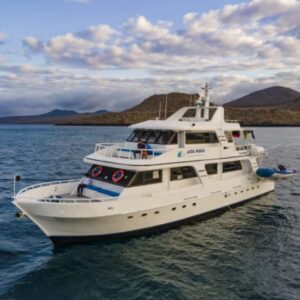


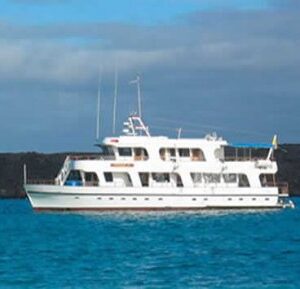
Specifications & Deck Plans
| Class: | Tourist Class |
| Capacity: | 16 passengers |
| Crew members: | 7 |
| Speed: | 9 knts |
| Energy: | 110V |
| Build year: | 1996 |
| Last remake: | 2019 |
| Length: | 19.53 mts |
| Beam: | 5.36 mts |


| Class: | Tourist Class |
| Capacity: | 16 passengers |
| Crew members: | 7 |
| Speed: | 9 knts |
| Energy: | 110V |
| Build year: | 1996 |
| Last remake: | 2019 |
| Length: | 19.53 mts |
| Beam: | 5.36 mts |
| DAY 1 | THURSDAY | AM: Arrive to Baltra Airport PM: Santa Cruz Island, Highlands |
| DAY 2 | FRIDAY | AM: Floreana Island, Post Office PM: Cormorant Point – Devil`s Crown |
| DAY 3 | SATURDAY | AM: Española Island, Suarez Point PM: Gardner Bay |
| DAY 4 | SUNDAY | AM: San Cristobal Island, Lobos Island / San Cristóbal Airport |
ITINERARY DAY BY DAY:
TURSDAY: SANTA CRUZ ISLAND
AM: Depart from Guayaquil or Quito
BALTRA ISLAND: This island was a strategic point during the Second World War. It is the main airport for the Galapagos Islands where tourists and colonists arrive and depart. At the Arrival at Baltra Airport, our naturalist English speaking guide will assists you. Transfer to the yacht. Welcome and briefing.
PM: Highlands: After lunch, visit to the Highlands to see the giant tortoises in their natural habitat. The tortoises are easy to spot, lumbering around eating grass and leaves and wallowing. Some highland birds, like cattle egrets, mockingbirds, finches or flycatchers can be seen here. After the hike return to the yacht. Dinner and briefing for next day.
FRIDAY: FLOREANA ISLAND
AM: Post Office Bay: Floreana, like several of the Galápagos Islands, has a history of whaling. During voyages of many months, whaling ships would call here to replenish stocks of food and water, and the sailors were o en keen to send news to loved ones that they were still safe. A tradition grew up here where sailors would leave a letter addressed home, hopeful that a ship heading back to port would pick it up and deliver it for them. This tradition of leaving letters and cards, and picking up others addressed to your home port meant that the location of this letter drop became known as “Post O ice Bay”. Decades later, the uno icial Floreana post o ice is still very active – why not leave a card of your own, or see if you could take one back to your home town for someone else?! As well as this charming tradition, Post O ice Bay boasts a pleasant beach, and there is a short hiking trail down to a cave, which is actually a lava tube that runs down to the sea. You will also have the opportunity to take a Panga through some of the nearby coves and mangroves from which you could see sharks, rays, and Wildlife you might see sea lions swimming around you.
PM: Cormorant Point: Cormorant Point is on the northern tip of Floreana, and you’ll land on a beach that sits between two volcanic cones. The sand on one of the beaches here has a noticeably olive-green color. This is due to a much higher than usual concentration of olivine crystals in the sand. Another beach is made up mainly of coral sand and is almost a brilliant white in comparison. This Galápagos site has a large lagoon which is favored by flamingos, their pink coloring contrasting with the green sand. There is some good snorkeling here, and you can o en spot rays in the shallows. There is a one mile hike available that takes you to higher ground and provides great views over the lagoon, and to both beaches on either side of the Point.
Devil´s Crown: Once a volcanic crater, the Devil’s Crown is now what remains of the eroded crater. The wind and waves have breached the east and west walls, leaving just the northern and southern crater edges showing above the water. Over thousands of years a coral reef has grown in the submerged center, creating one of the best snorkeling sites on the entire Galápagos. Exposed to currents, snorkeling in the Devil’s Crown isn’t a sedentary experience, and the surges can be quite thrilling! The marine life you will see is unparalleled, with colorful reef fish, sharks, rays and more. If water as it’s an experience not to be missed.
SATURDAY: ESPAÑOLA ISLAND
AM: Suares Point: Suarez Point is on the western tip of Espanola and is one of the most wildlife-packed of all the visitor sites in the Galápagos. A er a wet landing on a beach that’s frequented by Galápagos Sea Lions you can enjoy a 2 mile hike along a trail that will take you up around the cli s. The range of wildlife on show here is simply stunning. This is a great place to view the remarkable Galápagos Blue-Footed Booby as well as their cousins the Nazca Booby. You can also see the rare Waved Albatross at Suarez Point, where they use the cli tops to launch themselves into the air over the ocean. Another famous natural feature here is the blowhole. This geological formation funnels the incoming waves into a chamber where it gets compressed and then the air and seawater are forced out at great speed, making a spectacular plume of water shoot high into the air.
PM: Gardner Bay: Gardner Bay is a wonderfully sheltered area on the eastern shore of Espanola Island. It boasts one of the best beaches in the Galápagos, with superb white sand. There is nowhere better on the archipelago to simply sit back, relax, and take in the marvels of the wildlife around you. The beach here is home to a large colony of Galápagos Sea Lions, who seem to love sunbathing on the beach as much as we humans do! As well as the fun-loving Sea Lions you can also find Galápagos Mockingbirds here. These birds are full of curiosity, and have been known to come and investigate bootlaces, camera straps and other equipment! The wonderful Galápagos Green Sea Turtle can also o en be seen in the shallows here, and along with a large variety of colorful reef fish, this makes Gardner Bay a great place to swim and snorkel.
SUNDAY: SAN CRISTOBAL ISLAND
AM: Lobos Islad: Lobos Island is named a er the colony of Galápagos Sea Lions that live here, but they aren’t the only native Galápagos species that calls this narrow island home. You can see Galápagos Fur Seals basking here, and there is a nesting colony of Blue-Footed Boobies that come to Lobos each year to raise their chicks. There are one or two short hiking trails that lead into the center of the island, and this is always a peaceful place to visit.
Galapagos visitors tell us it’s one of their favorite visitor sites to just sit and soak up the Galápagos atmosphere. Back on the beach, the swimming and snorkeling is wonderful, and thanks to the island’s position close to the main shore of San Cristobal, the channel between them is sheltered and the turquoise water is crystal clear. This is a Galapatours favorite spot, so speak to one of our Galápagos specialists if you want help choosing an itinerary that includes a visit to this special place.
After this visit transfer to San Cristobal Airport for your return flight to Guayaquil/Quito
This is the end of the trip.
Important: Itineraries are unlikely to change significantly but are subject to change. Weather, wildlife breeding, safety concerns, instructions from the Galapagos National Park, specific abilities and interests of passengers as well as operational matters may cause your guide or captain to change the time or nature of visits. Your guide and captain will always endeavor to select the best itinerary within these limits.
| DAY 1 | THURSDAY | AM: Arrive to Baltra Airport PM: Santa Cruz Island, Highlands |
| DAY 2 | FRIDAY | AM: Floreana Island, Post Office PM: Cormorant Point – Devil`s Crown |
| DAY 3 | SATURDAY | AM: Española Island, Suarez Point PM: Gardner Bay |
| DAY 4 | SUNDAY | AM: San Cristobal Island, Lobos Island PM: Tijeretas Hill – Interpretation Center |
| DAY 5 | MONDAY | AM: Santa Fe Island, A walk on Sant Fe PM: South Plaza Island, A walk on South Plaza |
| DAY 6 | TUESDAY | AM: Santa Cruz Island, Charles Darwin Station. Transfer to the Baltra Airport, |
ITINERARY DAY BY DAY:
TURSDAY: SANTA CRUZ ISLAND
AM: Depart from Guayaquil or Quito
BALTRA ISLAND: This island was a strategic point during the Second World War. It is the main airport for the Galapagos Islands where tourists and colonists arrive and depart. At the Arrival at Baltra Airport, our naturalist English speaking guide will assists you. Transfer to the yacht. Welcome and briefing.
PM: Highlands: After lunch, visit to the Highlands to see the giant tortoises in their natural habitat. The tortoises are easy to spot, lumbering around eating grass and leaves and wallowing. Some highland birds, like cattle egrets, mockingbirds, finches or flycatchers can be seen here. After the hike return to the yacht. Dinner and briefing for next day.
FRIDAY: FLOREANA ISLAND
AM: Post Office Bay: Floreana, like several of the Galápagos Islands, has a history of whaling. During voyages of many months, whaling ships would call here to replenish stocks of food and water, and the sailors were o en keen to send news to loved ones that they were still safe. A tradition grew up here where sailors would leave a letter addressed home, hopeful that a ship heading back to port would pick it up and deliver it for them. This tradition of leaving letters and cards, and picking up others addressed to your home port meant that the location of this letter drop became known as “Post O ice Bay”. Decades later, the uno icial Floreana post o ice is still very active – why not leave a card of your own, or see if you could take one back to your home town for someone else?! As well as this charming tradition, Post O ice Bay boasts a pleasant beach, and there is a short hiking trail down to a cave, which is actually a lava tube that runs down to the sea. You will also have the opportunity to take a Panga through some of the nearby coves and mangroves from which you could see sharks, rays, and Wildlife you might see sea lions swimming around you.
PM: Cormorant Point: Cormorant Point is on the northern tip of Floreana, and you’ll land on a beach that sits between two volcanic cones. The sand on one of the beaches here has a noticeably olive-green color. This is due to a much higher than usual concentration of olivine crystals in the sand. Another beach is made up mainly of coral sand and is almost a brilliant white in comparison. This Galápagos site has a large lagoon which is favored by flamingos, their pink coloring contrasting with the green sand. There is some good snorkeling here, and you can o en spot rays in the shallows. There is a one mile hike available that takes you to higher ground and provides great views over the lagoon, and to both beaches on either side of the Point.
Devil´s Crown: Once a volcanic crater, the Devil’s Crown is now what remains of the eroded crater. The wind and waves have breached the east and west walls, leaving just the northern and southern crater edges showing above the water. Over thousands of years a coral reef has grown in the submerged center, creating one of the best snorkeling sites on the entire Galápagos. Exposed to currents, snorkeling in the Devil’s Crown isn’t a sedentary experience, and the surges can be quite thrilling! The marine life you will see is unparalleled, with colorful reef fish, sharks, rays and more. If water as it’s an experience not to be missed.
SATURDAY: ESPAÑOLA ISLAND
AM: Suares Point: Suarez Point is on the western tip of Espanola and is one of the most wildlife-packed of all the visitor sites in the Galápagos. A er a wet landing on a beach that’s frequented by Galápagos Sea Lions you can enjoy a 2 mile hike along a trail that will take you up around the cli s. The range of wildlife on show here is simply stunning. This is a great place to view the remarkable Galápagos Blue-Footed Booby as well as their cousins the Nazca Booby. You can also see the rare Waved Albatross at Suarez Point, where they use the cli tops to launch themselves into the air over the ocean. Another famous natural feature here is the blowhole. This geological formation funnels the incoming waves into a chamber where it gets compressed and then the air and seawater are forced out at great speed, making a spectacular plume of water shoot high into the air.
PM: Gardner Bay: Gardner Bay is a wonderfully sheltered area on the eastern shore of Espanola Island. It boasts one of the best beaches in the Galápagos, with superb white sand. There is nowhere better on the archipelago to simply sit back, relax, and take in the marvels of the wildlife around you. The beach here is home to a large colony of Galápagos Sea Lions, who seem to love sunbathing on the beach as much as we humans do! As well as the fun-loving Sea Lions you can also find Galápagos Mockingbirds here. These birds are full of curiosity, and have been known to come and investigate bootlaces, camera straps and other equipment! The wonderful Galápagos Green Sea Turtle can also o en be seen in the shallows here, and along with a large variety of colorful reef fish, this makes Gardner Bay a great place to swim and snorkel.
SUNDAY: SAN CRISTOBAL ISLAND
AM: Lobos Island: Lobos Island is named a er the colony of Galápagos Sea Lions that live here, but they aren’t the only native Galápagos species that calls this narrow island home. You can see Galápagos Fur Seals basking here, and there is a nesting colony of Blue-Footed Boobies that come to Lobos each year to raise their chicks. There are one or two short hiking trails that lead into the center of the island, and this is always a peaceful place to visit.
Galapagos visitors tell us it’s one of their favorite visitor sites to just sit and soak up the Galápagos atmosphere. Back on the beach, the swimming and snorkeling is wonderful, and thanks to the island’s position close to the main shore of San Cristobal, the channel between them is sheltered and the turquoise water is crystal clear. This is a Galapatours favorite spot, so speak to one of our Galápagos specialists if you want help choosing an itinerary that includes a visit to this special place.
PM: Tijeretas Hill: Translated, this is “Frigatebird Hill”, and it’s well named! This is a place where both endemic species of frigatebird, the Great Frigatebird and the Magnificent Frigatebird, share a colony. The hill itself o ers a wonderful view of Wreck Bay to the south and to Kicker Rock to the west, but it also provides the perfect opportunity for your Galapatours guide to tell you more about the two species of frigatebird to be found in Galápagos, and how you can tell them apart. There’s also a range of native plant species here. The beach at the bottom of the hill is a nice place to relax, and the waters here are safe for swimming and snorkeling perfect for cooling o a er your climb!
Interpretation Center Gianny Arismendi: The Gianny Arismendi Galápagos Interpretation center in San Cristóbal, Galápagos, aims to provide a complete history of the Galápagos and give visitors a more holistic understanding of these islands’ unique habitats and wildlife. There are also interesting exhibits covering the Galápagos’ human history, and the conservation e orts in place to preserve the archipelago, and undo some of damage human occupation has brought. For those who are interested in the geology of the archipelago there is a complete exhibit on the volcanic birth of the Galápagos and how this impacted on the habitats present here. Your Galapatours expert guide will be able to answer any further questions raised by your visit to the Center and can help you to link what you will learn here to what you will see as your Galápagos journey continues. Where does the name Gianny Arismendi come from? The Directorate of the Galápagos National Park recognized park ranger Gianni Arismendi Guerrero, one of the park rangers of San Cristóbal, for his 27 years of work dedicated to environmental education.
MONDAY: SANTA FE ISLAND AND SOUTH PLAZA ISLAND
AM: A walk on Santa Fe: Santa Fe is a small, flat island right in the center of the Galápagos archipelago, and is thought to be one of the oldest volcanoes here. Dating of the rocks below the water estimates they were formed almost 4 million years ago. Santa Fe had its own breed of Giant Tortoise that became extinct at some point in the 1800s due to being hunted for meat. There are two species that are unique to the island still present here – the Santa Fe Land Iguana and the Santa Fe Rice Rat. There is one visitor site on Santa Fe, and you will have a panga ride to a wet landing on the beach at Barrington Bay on the island’s north coast. From here there are two hiking trails. One is a short loop close to the beach that takes you into an Opuntia forest filled with these massive cactus. This is the best opportunity to see the Santa Fe land iguanas and also other species such as Galápagos Hawks. The second trail is a tougher proposition as it climbs quite steeply to the top of a cli from where you will enjoy stunning views over the island’s unspoilt interior. Back on the beach you can join the Galápagos Sea Lions who o en play in the waves and you can enjoy some wonderful snorkeling in the clear blue-green waters here.
PM: A walk on South Plaza: Whilst her twin, North Plaza, is closed to visitors, South Plaza is one of the best visitor sites in the Galápagos thanks to the large number of species present on her small area. The Plazas were formed as the result of a geological upli , and because this was uneven they both have cli s on their south sides and low lying shores on their northern coasts. The most noticeable (and noisiest) of South Plaza’s residents are her Galápagos Sea Lions, who have a large colony here. Less obvious are her land iguanas (the smallest in the islands), many marine iguanas and large numbers and varieties of seabirds. Inland is a mix of scrubby vegetation and giant opuntia cactus forest, providing food for the iguanas. As you follow the circular hiking trail you will come to the summit of the cli s here where you’ll be among countless nesting seabirds.
TUESDAY: SANTA CRUZ ISLAND
AM: Charles Darwin Research Station: The world famous Charles Darwin Research Center is just a 10 minute walk from downtown Puerto Ayora, and is the home of the non-profit Charles Darwin Foundation. Inside, you’ll find exhibits about the geography, geology and climate of the Galápagos, and the evolution of her unique species. There is also lots of information on the Foundation’s current conservation and education programs. As well as conducting it’s own key research, the Charles Darwin Center also hosts international scientists, and supports the work of government agencies like the Galápagos National Park. Next door is the site of the Galápagos’ first giant tortoise breeding center, where pioneering work has been done since 1965 for the preservation of these species. Here you can see newly hatched babies, up to juveniles and full-grown adults ready to be released back into the wild.
After this visit transfer to Baltra Airport for your return flight to Guayaquil/Quito
This is the end of the trip.
Important: Itineraries are unlikely to change significantly but are subject to change. Weather, wildlife breeding, safety concerns, instructions from the Galapagos National Park, specific abilities and interests of passengers as well as operational matters may cause your guide or captain to change the time or nature of visits. Your guide and captain will always endeavor to select the best itinerary within these limits.
Reviews
There are no reviews yet.